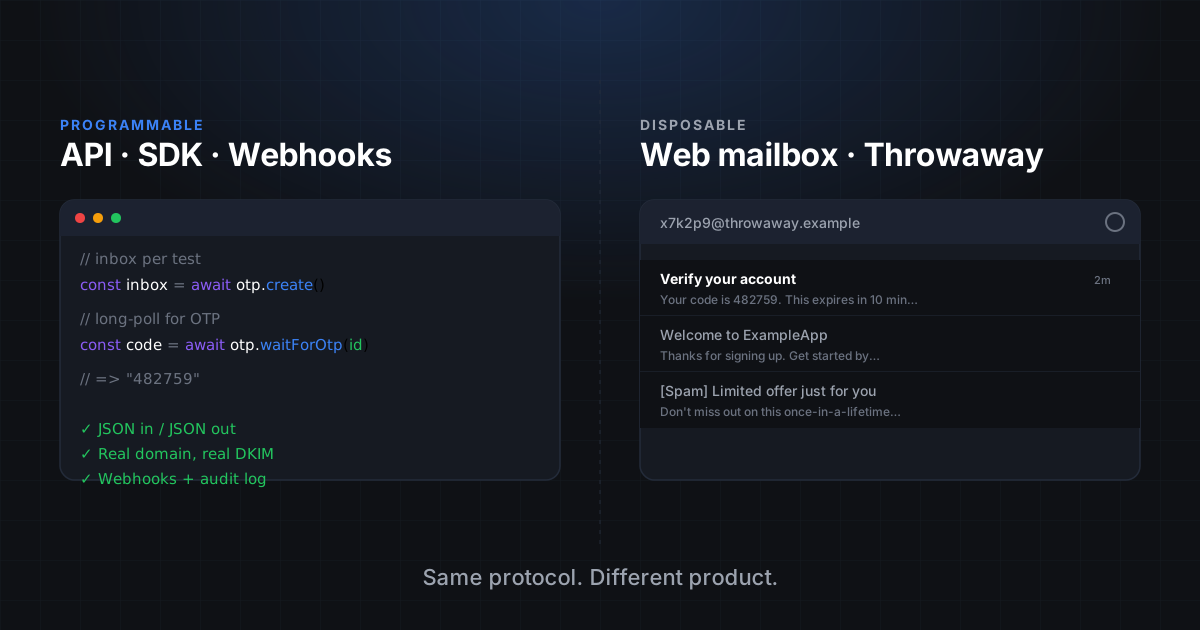
Programmable Email vs Disposable Email: A Developer's Guide
What's the difference between disposable inbox sites and programmable email APIs? When to use each, with code examples.
The terms get used interchangeably and they should not be. “Disposable email” and “programmable email” sound similar — both let you receive mail at an address you do not own forever — but they solve different problems, and the cost, capability, and constraints are not at all the same.
This post defines both terms precisely, walks through the five practical differences, gives you a decision tree for picking, and shows what a programmable-email integration actually looks like.
Definitions
Disposable email is the category of free, browser-based services where you visit a URL, get a randomly-generated address on a public domain, and read incoming mail in a webmail-style UI. The address typically lasts for ten to thirty minutes. There is no API, no script-ability, no persistence guarantees, and the domains are often on signup blocklists.
Programmable email is the category of services that expose a real internet-facing inbox as a REST API. You create an inbox via an API call, you receive structured JSON when mail arrives, you can wait for a specific message via a long-poll primitive, and you can pull out a one-time-password from the body without writing your own regex. The address lives on a real domain with proper MX, DKIM, and SPF records.
These are not the same product with different price tags. They serve different audiences and different jobs.
The five practical differences
1. API access
The defining difference. A disposable-email site is a web page; a programmable-email service is a REST API with SDKs. If you cannot script it, you cannot integrate it into CI, into an agent loop, into a test fixture, or into any kind of automation. Everything else flows from this.
Concretely:
// Programmable email — three lines, fully scripted
import { CatchOTP } from '@catchotp/sdk';
const otp = new CatchOTP({ apiKey: process.env.CATCHOTP_KEY! });
const inbox = await otp.inboxes.create({ mode: 'ephemeral', ttlMinutes: 10 });
# Disposable email — there is no equivalent. You open a tab.2. OTP and link extraction
Disposable inboxes show you the email body and trust you to copy the OTP out by eye. Programmable email parses the body, deduplicates URLs, and exposes a structured JSON object — including a pre-extracted OTP for the common patterns.
const message = await otp.messages.waitFor(inbox.id, { timeoutSeconds: 30 });
console.log(message.otp);          // → "493021"  (auto-extracted)
console.log(message.links);        // → [{ url: "https://example.com/verify/abc..." }]
console.log(message.subject);      // → "Verify your email"
console.log(message.text.length);  // → 482
The structured JSON is the part that makes this a developer tool rather than a UI.
3. Real-time waiters
This is the primitive that surprises people who have only used disposable email. Both Cypress and Playwright (and any agent) can long-poll on a single HTTP request that resolves the moment the matching message arrives. There is no polling loop, no sleep(10), no race condition between the test and the email.
// Long-poll: connection stays open until the message lands or the timeout fires
const code = await otp.inboxes.waitForOtp(inbox.id, { timeoutSeconds: 30 });
p50 latency from email send to waiter resolution is around 600ms. p95 is under 1.2s. That is the difference between a flaky test suite and a reliable one.
4. Persistence and TTL
Disposable inboxes typically expire on a fixed schedule (10-30 minutes) with no control. Programmable inboxes let you choose: ephemeral with a TTL between 5 minutes and 30 days, or persistent until you delete them.
Why persistence matters: regression suites that exercise long-running flows (a 48-hour expiry test, a billing-cycle webhook) need an inbox that survives between test runs. You cannot do that on a disposable site.
5. Automation
The point of every other difference compounds here. With programmable email, you can:
- Build a CI pipeline that creates an inbox, drives a signup, waits for the OTP, asserts the post-login state, and tears the inbox down — all in one test.
- Wire an MCP-aware agent to a per-task inbox so it can register accounts on services it needs to use.
- Create per-pipeline scoped API keys so a leak in one project does not blast-radius the others.
- Set up webhooks to fire into your QA management tool the moment the email lands.
None of this is possible with a disposable-email site, regardless of how much time you spend wishing it were.
A side-by-side comparison
| Concern | Disposable email | Programmable email |
|---|---|---|
| API access | None | REST + SDKs + CLI + MCP |
| OTP extraction | Manual (eyeball) | Auto-parsed |
| Wait pattern | Refresh page | Long-poll waiter |
| Persistence | 10-30 min, no control | TTL or persistent |
| Domain blocklist status | Often blocked | Not on standard lists |
| Per-pipeline isolation | None | Scoped API keys |
| Audit log | None | Per workspace |
| Free tier | Yes (ad-supported) | Yes |
| Pro tier | N/A | $29/mo |
A decision tree
Walk through this in order; stop at the first “yes.”
- Do you need to copy a code by hand for a manual signup right now, and you do not care about persistence? → Disposable email is fine.
- Do you need to run any of this in CI, even occasionally? → Programmable email.
- Do you need real DKIM/SPF coverage to exercise your transactional provider’s full path? → Programmable email.
- Do you need an audit log, scoped keys, or webhooks? → Programmable email.
- Are you wiring an AI agent that needs to handle email-based flows? → Programmable email, ideally with an MCP integration.
Disposable email keeps its place in the toolkit for the manual one-off case — and only that case.
A complete programmable-email example
Here is the full shape of a programmable-email integration. This is a Playwright test that signs up a user, retrieves the OTP from the verification email, completes verification, and asserts the post-login state.
import { test, expect } from '@playwright/test';
import { CatchOTP } from '@catchotp/sdk';

const otp = new CatchOTP({ apiKey: process.env.CATCHOTP_KEY! });

test('user can complete email OTP signup', async ({ page }) => {
  // 1. Spin up a per-test inbox
  const inbox = await otp.inboxes.create({ mode: 'ephemeral', ttlMinutes: 10 });

  // 2. Drive the signup form
  await page.goto('https://example.com/signup');
  await page.getByLabel('Email').fill(inbox.address);
  await page.getByRole('button', { name: 'Continue' }).click();

  // 3. Block on the OTP — long-poll, no sleep
  const code = await otp.inboxes.waitForOtp(inbox.id, { timeoutSeconds: 30 });

  // 4. Submit and assert
  await page.getByLabel('Verification code').fill(code);
  await page.getByRole('button', { name: 'Verify' }).click();
  await expect(page.getByRole('heading', { name: 'Welcome' })).toBeVisible();

  // 5. Optional: clean up explicitly. TTL would handle it anyway.
  await otp.inboxes.delete(inbox.id);
});
Five steps, real inbox, real OTP, real assertion. That is the entire test.
Why this category exists
The honest answer is that the existing options were uncomfortable. Browser-disposable sites were unscriptable. Self-hosted SMTP catchers did not exercise the production path. Enterprise platforms were priced for the Fortune 500. Pointing the signup at a personal Gmail polluted the real inbox and was a security disaster.
Programmable email is the API-shape that the API-economy has produced for almost every other developer primitive: receive-side email, but with the same shape as Stripe for payments, Twilio for SMS, or Algolia for search. Small surface area, real SDKs, sensible pricing, scoped credentials.
Common misconceptions
Three things people assume about programmable email that are not true.
”It is the same as a disposable inbox with a UI on top”
It is not. The defining feature is the API and the OTP-extraction; the UI is a convenience for debugging failures, not the product. Calling them “the same” is like calling Twilio “SMS but with a developer dashboard.” The dashboard is incidental.
”The waiter is just polling under the hood”
It is not. The waiter is an HTTP long-poll: the connection stays open server-side until the matching message arrives or the timeout fires. There is no client-side polling loop. The model matters because the latency floor is “as fast as the message arrives” rather than “as fast as your polling interval permits."
"We will outgrow the free tier the moment we go to CI”
Most teams do not. The free tier on catchotp covers 5 inboxes and 1,000 messages a month. A small CI pipeline running a few hundred email-using tests a month fits comfortably. The upgrade trigger is usually parallelism (more than 5 concurrent inboxes) or retention (debugging yesterday’s failure).
Cost of switching
If you currently have email-using tests on a different tool, switching usually means:
- Replacing the test fixture’s inbox-creation call with
otp.inboxes.create - Replacing the polling loop with
otp.inboxes.waitForOtp - Updating the CI secret name
Two files, an afternoon. The risk profile is low because the rest of the test logic does not change — you are swapping the receive-side primitive, not rewriting the test.
Try the programmable side. Free tier with 5 inboxes and 1,000 messages a month — enough to evaluate the difference. Start free or view pricing.
Related reading
- Best Email Testing Tools for Developers in 2026
- How to Test OTP Flows in 2026
- The OTP testing use case and the burner emails use case walk through real integrations.
The shorter version: if you are scripting it, you want programmable. If you are not, disposable is fine. The hard part is being honest about whether you are about to start scripting.