Email-aware QA pipelines, without the ops burden.
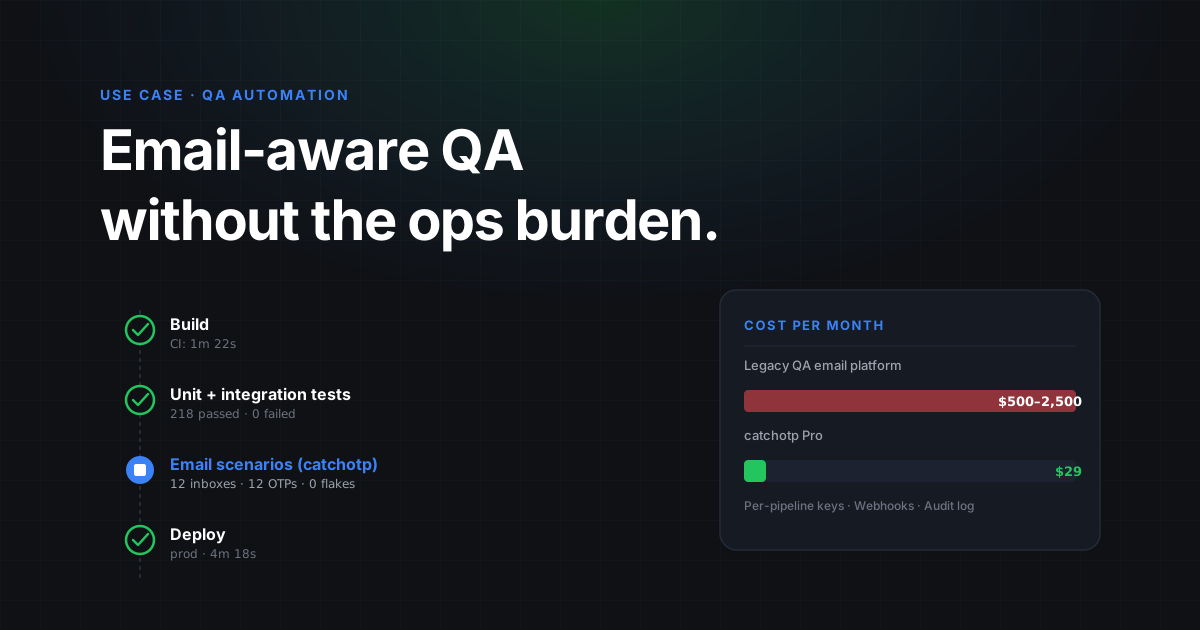
QA teams pay $500-2,500 a month for email-testing platforms with features they barely use. catchotp Pro is $29/mo and has the primitives that actually matter — inbox, waiter, OTP, webhook.
- Per-pipeline scoped keys
- Webhooks for TestRail/Xray
- Audit log per workspace
The problem with QA-and-email today
Most QA suites avoid testing email-dependent flows entirely because the infrastructure is painful. Standing up a real receive-side means an SMTP server, a sub-domain, DKIM, MX records, an archive, and an API to read mail back out. None of that is what a QA team wants to be on the hook for.
The escape hatch is an enterprise email-testing platform — usually with a five-figure annual contract, a long onboarding, and ninety percent more features than the QA team wanted. The platforms are good, but they are priced for the Fortune 500. A six-person QA team paying $1,800 a month for "the inbox part" is the common pattern we see.
catchotp is the inbox part: a programmable email API with the right primitives, a free tier, and a Pro tier that is roughly one-thirtieth the price. If you need render previews across eighty mail clients, you still want the enterprise platforms. If you need to assert that a password-reset email arrived and contained the right link, this is the lighter option.
What catchotp gives a QA team
Per-pipeline keys
Scoped API keys per pipeline or environment. A leak in one project does not blast-radius the others. Rotate any key without touching the others.
Webhook + REST
Push notifications to TestRail, Xray, Zephyr, or your own CI handler. Or pull on a schedule. Both shapes are first-class.
Audit log
Every read, every parsed OTP, every API call — logged per workspace. Replayable for failure debugging and for compliance reviews.
Enterprise platforms vs catchotp
| Feature | Enterprise platforms | catchotp Pro |
|---|---|---|
| Monthly price | $500-2,500 | $29 |
| Inbox API + waiter | Yes | Yes |
| OTP auto-extraction | Partial | Yes, override supported |
| Webhooks to TestRail/Xray | Yes | Yes |
| Render preview (80+ clients) | Yes | No |
| Deliverability scoring | Yes | No |
| Onboarding time | 2-4 weeks | Same afternoon |
Honest take: if your QA suite hinges on render preview or deliverability scoring, you want the enterprise platform. If it hinges on the inbox primitive, catchotp is the lighter and cheaper choice.
A pytest fixture you can reuse
Yields one inbox per test, cleans up afterward. Compose with any HTTP client, browser driver, or QA framework you already use.
# conftest.py
import os, pytest
from catchotp import CatchOTP

@pytest.fixture(scope="session")
def otp_client():
    return CatchOTP(api_key=os.environ["CATCHOTP_KEY"])

@pytest.fixture
def inbox(otp_client):
    """One inbox per test. TTL handles cleanup."""
    box = otp_client.inboxes.create(mode="ephemeral", ttl_minutes=15)
    yield box
otp_client.inboxes.delete(box.id)QA automation FAQ
How does this compare to a $500/mo enterprise email-testing platform?
Can I integrate with TestRail, Xray, or Zephyr?
What about flaky tests caused by email arrival timing?
How do I handle multiple environments (staging, preview, prod-like)?
Can the QA team see what arrived in the inbox?
Related use cases
E2E signup flows
Per-test ephemeral inboxes for Playwright and Cypress.
OTP testing
Drop-in waiters for one-time codes in any test runner.
Read the SDK reference or jump straight to pricing.
Replace the line item with $29/mo.
If your QA suite uses the inbox primitive but not the rest, catchotp is the cheaper option.